
Ozone Layer Shows Signs of Healing
- Oct 2, 2025
- 2 min read
By Anuki Malimbada Liyanage ‘27, Editor in Chief of Faith and Formulas Blog

This shows the maximum yearly extent of the ozone hole from 1979 to 2024. Credit: Copernicus Atmosphere Monitoring Service (CAMS).
Can you imagine a world where sunscreen didn’t exist? Well, it would be even worse without our ozone layer. For decades, this thin shield in the stratosphere that protects us from ultraviolet radiation was one of scientists’ biggest concerns for our environment. In 1985, British Antarctic Survey scientists Joseph Farman, Brian Gardiner, and Jonathan Shanklin reported a hole in the ozone layer in the journal Nature over Antarctica, sparking worry around the globe. This hole was linked to man-made chemicals such as chlorofluorocarbons, or CFC’s, which were used in packaging, air conditioners, and even hair sprays before being banned in 1987 under the Montreal Protocol, one of the most successful environmental treaties in history.
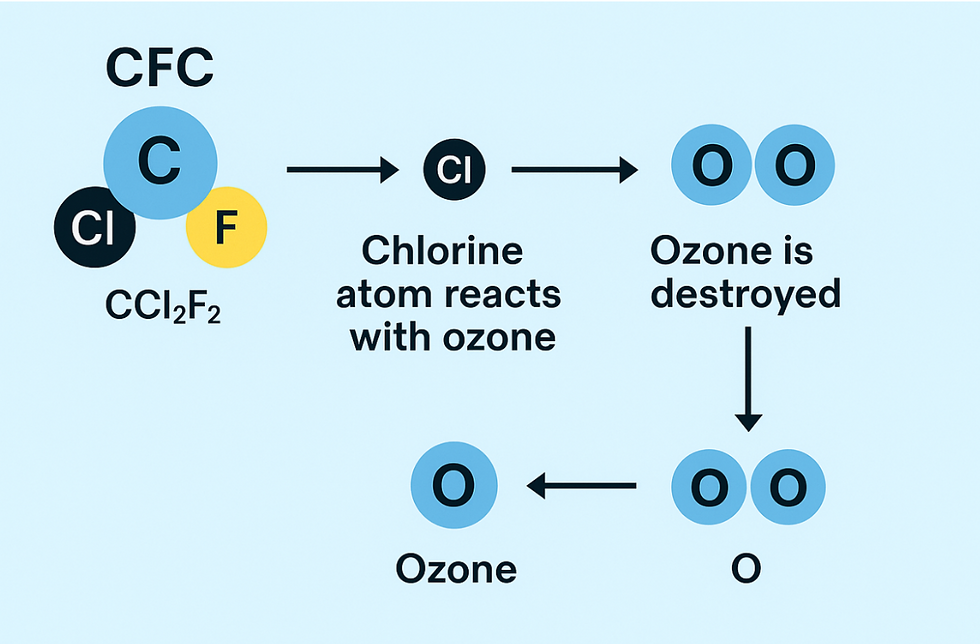
This Displays: How CFCs damage the ozone: UV light frees chlorine from CFCs, and that chlorine breaks apart ozone molecules (O₃) into oxygen. One chlorine atom can repeat this cycle and destroy thousands of ozone molecules
Now, there is good news: the ozone layer is healing! A September 2025 report by the World Meteorological Organization shows that satellite data proves that the Antarctic ozone hole is shrinking compared to previous years and the ozone layer is on track to recover in the coming decades. While the low level of ozone depletion observed in 2024 was due to natural factors in the atmosphere, global actions such as banning CFC’s have shown a huge long term improvement on the health of our ozone layer.
This work would not have been possible without the various fields that work in environmental science and beyond, such as atmospheric chemistry, which looks at the study of the chemical composition of our atmosphere. Or remote sensing, which utilizes instruments like satellites, aircrafts, and drones to obtain information about Earth, such as oceanography and ozone recovery. We cannot forget about the people who work in environmental policy, who sit down and draft protocols, amendments, and treatments to protect our planet from environmental threats. Overall, there are a plethora of fields that work day and night to keep our planet safe.
September 16th is World Ozone Day, designated by the United Nations to celebrate our collective efforts as a planet to heal the ozone layer. However, the work doesn’t end there: the UN secretary general António Guterres of Portugal emphasized how important the Kigali Amendment would be, stating, “Implementing the Kigali Amendment could avoid up to 0.5 degrees Celsius of warming by the end of the century.” He continued, “Paired with energy-efficient cooling, we could double these gains.” The Kigali amendment would phase down hydrofluorocarbons (HFCs), which were the replacement for CFCs. To avoid further global warming.
While the world has a long way to go, this story proves that when we cooperate together, we can make groundbreaking changes that help our planet. Though it may seem daunting, when we work through it one step at a time, anything is possible.

Comments